Showing posts with label field trip. Show all posts

Wednesday, October 16, 2013

Kona Brewing

Two weekends ago my wife and I went to visit my mom and step-dad in Kona on the Big Island. We were there for three days, and visited two breweries during that time. Last week I wrote about our trip to the Big Island Brewhaus; this week I'm posting about our visit to Kona Brewery.


This isn't the first time I've been to the Kona Brewery Brewpub--my wife and I stopped by once around six years ago. This is, however, the first time I've been to the brewery since it was acquired by Craft Brew Alliance, which also owns Red Hook in Seattle and Widmer in Portland. The brewpub has undergone some serious changes since that acquisition, but in all honesty (and despite my anti-big business, commie-pinko leanings) the changes I noticed during this recent visit seemed positive.

First of all, and perhaps most-importantly, the Kona brewpub offers more beers than ever before. I've had their bottled offerings, and I stopped by the Koko Marina pub on Oahu earlier this year, but the Kona location offered another half-dozen "seasonal" beers beyond that, and the server mentioned them as if they were all on tap and available right then (instead of seasonally). I'm guessing that there are more than 15 beers to choose from. I tried three beers--a Marzen, a Steam, and a Red--that I'd never had before.

Secondly, the seating area is largely expanded--and very nice. Last time I stopped by you had the choice of sitting inside--which was a bit dim and dank--or sitting on the outside, covered porch--which was also a bit dim and dank. Now they've significantly increased the outside seating: dozens of sunshade-covered tables running along miniature palm planters that are crawling with green geckos. It's a very nice place to drink yourself mellow, and the food was good too.

And thirdly, the money-flood that seems to be hitting Kona Brewing is being used in some cool projects. They've installed a ton of PV solar panels to offset their energy use, and they've made some other environmentally-oriented decisions. They commissioned a huge mural on the side of the warehouse. They've turned their brewing facility into a pretty massive operation (you can see the keg yard in the picture below) and both the brewery and restaurant seem to be hopping with staff--so lots of good jobs for people in Kona.

Wednesday, October 9, 2013

Big Island Brewhaus

Last weekend my wife and I flew over to the Big Island to visit with my mom and step-dad, who were in Kona for vacation. We stopped in at both the Big Island Brewhaus and Kona Brewing. I plan on writing about my impressions of both places, starting with Big Island Brewhaus this week.


Big Island Brewhaus is located in a little town called Waimea. It's about an hour's drive from Kona, and about a million miles away in terms of atmosphere: Waimea is paniolo (Hawaii cowboy) territory, with lots of ranches and cattle and big trucks and motorcycles. The altitude is 2670 feet above sea level, and the air is cooler and moister than Kona seaside air. The people in the area struck me as more of a mix of European and Polynesian ethnicity, whereas Honolulu definitely reflects more Japanese and Chinese influence.

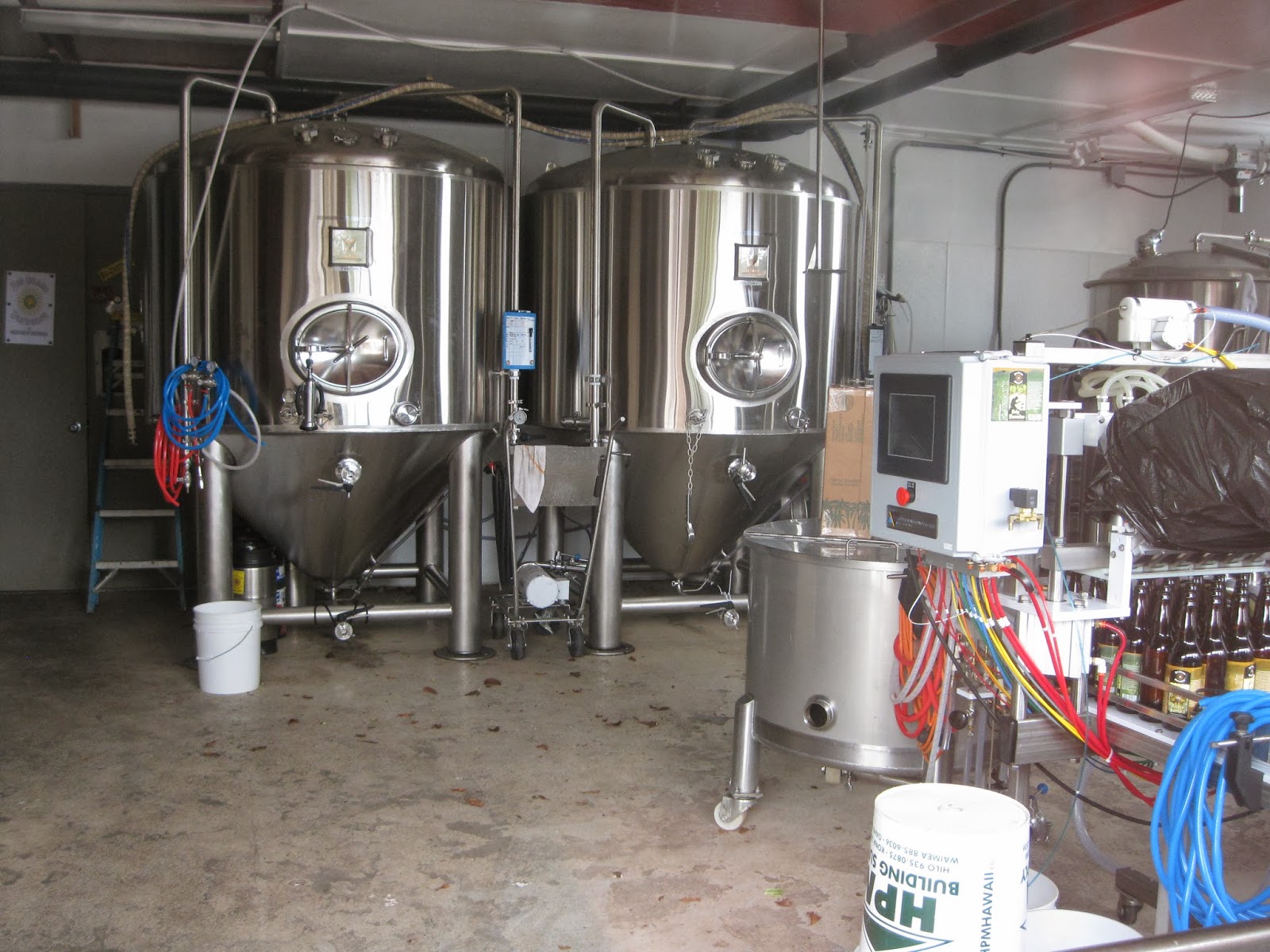
The Big Island Brewhaus brewery itself is located in a tiny little strip mall, alongside a hunting supply shop and a bicycle store. The place was locked up and empty when we were there--the only sign of life coming from a bubbling barrel of trub on a pallet out front--but I peeped through the window to get a look at the brewing set-up. I'm guessing it's around 15 barrel system, with around four fermenters. They've also got a small bottling system for the 22 oz bottles you can get on Oahu. There's a picture below--if you've got a different guess about system size, or if there's anything else interesting you notice from the picture, please feel free to mention it in the comments section of this post.


Big Island Brewhaus also owns and runs a small Mexican restaurant and bar, located in a free-standing building on the property. We went in for lunch and got a sampler of every beer they had available (picture below). Despite the German-influenced name of the brewery, the beer lineup didn't swing toward lager-dominance. Of the eleven beers we tried, about half of them were Ales, and the majority of the rest of the lineup used Belgian-yeasts. Here's a link to the beer descriptions they list on their website, though the list doesn't reflect all of the beers on hand during our visit. Another thing I noticed: grain-wise, the beers on hand seemed to focus on what I think of as "mid-range" grain bills--mostly pale and some caramelized grains, mostly 5-7% alcohol. The only beer that had any roast to it was the White Mountain Porter--I guess they also brew a Guinness style stout, but it wasn't on hand when we were there.

All the beers tasted good to me. My favorite was a Sierra Nevada-styled beer called Paniolo Pale Ale, and what I loved about it was the way the cascade hops came through in the aroma. They smelled super green and fresh, just like the smell you get right when you throw the hops in the boiling kettle. And that helped solidify another thing I've been noticing about beer on the islands--that heady, resinous aroma that I love about West Coast Pale Ales and IPAs is hard to come by here, even in beers that are famous for it like Sierra Nevada, because boat-shipped beers are never gonna be as fresh as what you'll get on the mainland. One more argument for homebrewing in Hawaii.


Another beer that stood out to me was, I think (memory's not too clear on this one), a Pale Ale brewed with ginger. I swear to Ninkasi the beer tasted almost exactly like the Sage Pale Ale I brewed a couple months back, though they say they used ginger and not sage.

As for the food, it was pretty good--probably better than a lot of the Mexican food I've had in Hawaii, but still not up to California standards. My wife gives them super-extra-credit for having real chips--actual tortillas cut into triangles and then deep fried. But my step-dad thought the hot-sauce was seriously lacking in sufficient hotness. I'm not a spicy food connoisseur, but I agree the spice seemed pretty tame. And I also think it's worth noting that the dude who served us was friendly and helpful and on top of it, even though he was working alone during the lunchtime rush.

Friday, March 29, 2013

Kona Brewing Pub on Oahu


What's worth knowing about Kona Brewing's pub on Oahu?

As far as I know, it's one of only two places on Oahu where you can get a discount for being a member of the American Homebrewers Association. I've only been once so far, but they gave a ten percent discount to the entire bill--not just the beers. And that discount was added on top of the already lowered happy-hour prices (which has discounted appetizers as well as beers). In the end, as brew pubs go, it's a pretty good deal.

They don't actually brew the beer here. But they do serve beer that was brewed in Hawaii, at the Kona Brewery on the Big Island. My understanding is that the Hawaii-brewed beer is draft only, not available in bottle, which brings up the next point:

They've got beer you can't get anywhere else. Well, anywhere else except for the other Kona Brewpub, on the Big Island. I tried the Duke's Blonde, the Lavaman Red, and the Black Sands Porter. They were all pretty good, though I'd say the Porter was my favorite--it's pretty mellow as Porters go, which is a nice alternative to the heavier Kona Pipeline Porter; and since it's made without coffee, it doesn't have the caffeine kick of the Pipeline Porter, either, so it won't keep you up at night.

And what's the other place on Oahu that gives the AHA discount? Gordon Biersch, at Aloha Tower.

Tuesday, March 19, 2013

Aloha Beer Company tour


On Saturday I stopped by Aloha Beer with my girlfriend and her mom. The beer hall door's were locked, and the guy I'd set the tour up with was nowhere to be seen. We stood around in the parking lot, watching the constant stream of cars pulling in for lunch at Sam Choy's (the restaurant that shares the building with Aloha Beer), waiting for the guide. After twenty minutes, I decided to sneak into Sam Choy's to use the bathroom, and while I was in the restaurant I saw a few guys standing up by the brew equipment. I went up to say hello, and one of the guys was the Brewmaster himself, Dave Campbell. He hadn't heard anything about the tour, but he said he'd show us around for a few minutes anyway.

In the end, Campbell gave us almost an hour and a half of his time, and he generously responded to all of our questions. I went from standing in the parking lot and looking like a chump in front of my girlfriend's mom, to getting a private tour of Oahu's up-and-coming brewery with one of the father's of Hawaii's craft beer scene. To say I felt grateful would be putting it mildly.

Campbell was born and raised in Hawaii, and has been involved with craft brewing since 1985. He opened Oahu's first homebrew shop, and he's been Brewmaster for Sam Choy's since 1997--well before the current wave of craft-beer enthusiasm started reaching Hawaii's shores. Throughout our tour he answered my questions candidly, never hesitating to voice sometimes controversial opinions about the beer scene on the islands. Following below is my summary of the points I found most interesting. (Keep in mind that I didn't take notes during the tour, so my memory of the finer details might be slightly off.)


(This picture and the one below where taken from the Aloha Beer Company website.)

Aloha Beer is brewed for the local Honolulu palate. I'd read this in an interview with Campbell a while back, and to tell the truth, I was a bit skeptical of the wisdom to that approach. The "Honolulu palate" in the article referred to the local predilection for "green bottle beers"--namely Heineken and other mass-produced brews like Coors Light and Bud. It didn't seem likely, in my mind, that fans of such beers would appreciate craft beer. Why waste your time and energy on an audience that's not only satisfied, but even claims to prefer, the cheapest and blandest beer available?

Campbell explained his view that the local predilection for "green bottle beers" isn't just evidence of herd-mentality. It comes in response to the Hawaii climate. Heavy-bodied, high-alcohol beers like the Double IPAs and the Imperial Stouts that are so popular on the mainland don't go down as easy here, where it's usually hot and humid. People prefer lighter, refreshing beers because they go better with the heat. "How many local guys do you know that'll drink a twelve-pack of Coors Light every day after work? I know plenty," he said. "We wanted to brew a higher-quality version of the types of beer they like."So Aloha Beer aims to be more "session-oriented." "The session beer is coming back."

Aloha Beer is passionate about tradition. When I asked Campbell if he'd ever consider using some of the more exotic ingredients that are featured in other Hawaii brewing company beers--like Maui Brewing featuring a beer with toasted Papaya seeds, or Kona brewing with its Coconut Brown--he scoffed. "That stuff seems sort of gimmicky to me," he said. "I used to brew a beer with breadfruit, back when I owned the homebrew shop, but the truth is it wasn't very good."

For Campbell, who graduated from college with a degree in History, the exploration of traditional styles is much more interesting than wild experimentation. There's a wide variety of experiences available in traditional styles. Why not explore the wealth of knowledge that already exists?

Campbell's next beer might serve as an example of how this approach can still be used to introduce drinkers to new experiences. He's planning on using a portion of ocean water in an upcoming brew. Salt is a traditional ingredient in certain long-established styles, like Gose, but it's rarely seen today.

His use of ingredients does sometimes include other locally-produced ingredients, like honey, but only when such ingredients fit with tradition. Honey has been used in beer for thousands of years, he said. It's been proven to work. Coconuts, not so much. If you want to experience a coconut flavor with your beer, try pairing a porter with a slice of haupia (coconut) pie. But don't make the beer taste like coconut. Let the beer taste like beer.

He also reminded me that the main ingredient in beer is water, and Aloha sources its water locally.


Aloha beer has some big changes coming up. Right now Campbell is focusing on keeping the kegs filled and the taps running. He wants to keep producing as much beer as his system can handle. But once the dust settles from Sam Choy's restaurant shutting down (which is scheduled for the end of this month), Aloha is planning to expand. They'll be taking over the bar in Sam Choy's, turning it into a sort of "beer sanctum" to offer local beer fans a place to congregate (instead of the current "club-feel" of the Aloha Beer hall). And the beer-production size will double, or possibly triple, which will give Campbell a chance to explore more of those traditional styles he's so fascinated by.

And what's the current Aloha Beer brewing set-up and process like?. This subject in particular is hard to discuss accurately, since I didn't take notes, but here's what I remember: The brew system size is around 16 barrels, which means a capacity of around 500 gallons. They typically use between 800 and 1000 pounds of grain in a batch, and the grain comes in what looked like 40-pound bags (so the brewers have to lift at least 20 bags up into the mill, and they climb on a rickety stack of milk crates to do it--consequently, Campbell is a pretty brawny guy). The boil goes on for an hour and a half to two hours, in order to insure complete isomerization of hop bitterness, and to evaporate 5 to 7% of the volume of the wort. The kettle is steam-heated, so no caramelization occurs during that boil. I think they had seven fermenters, and they're doing their best to keep them full at all times. Campbell gets his yeast from Wyeast.

And finally, a bit on the Maui brewing versus Kona Brewing controversy. For those who don't know, Hawaii's biggest brewer is Kona Brewing, and they've been under attack by Maui Brewing for brewing some of their beer in the mainland. I asked Campbell what he thought of the controversy, and he expressed a pretty pronounced skepticism in Maui Brewing's "local" credentials. Garrett Marrero (founder of Maui Brewing) moved here from San Diego like six years ago, got a tribal tattoo, and now he wants to tell us what qualifies as "local", Campbell said. And he added that Kona Brewing's been here since the start of the brewing movement in Hawaii, and that that gives them at least as much claim to "local" status as Maui Brewing.

Tuesday, February 26, 2013

English Ales


When I was 18 I left my mom's house in southern California and started wandering. After about a year I ended up in Plymouth, England, and found work in a pub called the China House. My time there served as my introduction to real ale--the bulk of the beer I'd drank up to that point was the stuff that came in 40 oz bottles--and with that introduction began my love of good beer.

On last year's trip we passed through England, and I took the opportunity to reacquaint myself with the beers that first inspired my love. English and Irish styles remain my favorite types of beer, and there are many wonderful American interpretations of those beers, but the beer in England is a different sort of thing. Here are some of the things I noticed:

English Ales are generally very low in alcohol. In the States you'd be hard pressed to find many ales below 4% abv, but in England they're common. In fact, the typical pub probably carries more ales that are below 4% abv than above it--I even tried a few ales that were below 3%! I asked a brewer about it, and he told me that it relates to the cultural role of the pub in English society. The pub (which is short for "public house") exists as a sort of communal "living room" for the English people, and it's not unusual to stop by for a few beers on a daily basis. The goal is to have a drink, chat with some friends, read a paper or a book, and relax. It's not just an end-of-the-week-let's-party sort of place, like American bars are apt to be.

English Ales are generally served from the cask. In America, most beer that doesn't come from a bottle or can comes from a keg, and kegs are served on draft. That means the beer vessel (the keg) is air-tight, and some sort of pressurized gas (usually carbon dioxide) is used to force the beer out. In England they serve lagers that way, but not ales. English ale typically gets out of the cask and into your glass through the use of a hand-pump, or plain old gravity, and that's significant for several reasons. Firstly, any carbonation in the beer comes from the efforts of the yeast, which normally means the beer is pretty still compared to what we're used to in America. (You'll still have a nice foamy head, but there won't be bubbles racing up the side of the glass, and the beer won't have the same bite.) Secondly, casks aren't air-tight--air has to be able to enter the cask to replace the beer that exits (otherwise you'd have a vacuum, and the beer wouldn't flow). And since the beer in the cask comes into contact with air, it will eventually go stale (oxidize). So casks are smaller than kegs, and if there's ale left in a cask after a week or so, it might get poured down a drain instead of into a glass. (I think this adds a whole new level of interest to the experience of beer-drinking--on top of all the other factors you also get variability relating to freshness.)

English Ales are generally served at "cellar" temperature. Cellar temperature is often just a little cooler than the temperature in the pub, which means your ale will be cool but not ice-cold. And frankly, it makes sense. With a lager, as compared to an ale, the beer usually aims to be crisp, clean, and delicate in flavor. Serving a lager cold helps to emphasize those features. But ales are more about being round, flavorful, even fruity. You want to be aware of the yeast's presence for more than just the alcohol it produces--you want to be able to taste it. If you serve an ale ultra-chilled, you rob it of the chance to let its flavors really shine forth.

English Ales are influenced by tradition more than innovation. This is more of a "personal opinion" sort of note, but I think it merits mention. England is an old country, with a sense of self that stretches back well beyond America's approximate two and a half centuries of existence. And, as far as I know, England never went through any sort of alcohol-free era that could be compared with the U.S. prohibition period of 1920-1933. In Britain, beer isn't some newly rediscovered craft, it's a longstanding part of life. (Also, England's economy isn't as oriented toward no-holds-barred capitalism as our American economy is, so they aren't as affected by business investors clamoring for the next big thing.) The result is a culture that, compared to the U.S., skews more toward respecting-what-has-been than fantasizing-over-what-could-be. My girlfriend and I visited a brewery during our recent trip (York Brewery, in... York), and it was decidedly free of "cutting edge" equipment. In fact, it was even surprisingly free of today's standards of sanitation. In England they don't seem as interested in the possibility of using new technology to control the beer-making, or serving, process. They don't want to artificially cool the beer to a specific temperature--whatever the temperature in the cellar is is good enough. They don't want to hold exact mash or fermentation temperatures either, or maintain a controlled environment that prevents any chance of contamination (the York Brewery used open-topped fermentation vessels, and relied on the foam krausen as the beer's only protection; maybe they're relying on dominant yeast colonies, built up in the brewery walls over decades, to prevent anything else from being able to gain a foothold). In fact, while we dream of what's next in America, in England they've got groups like CAMRA, which are actively working toward protecting traditions, and which wield surprising influence in the British beer industry.

The end result of the four above-mentioned things is a unique beverage, often quite distinct from what we think of as beer in the U.S. English Ale strikes me as rather wholesome and gentle in its nature. Sometimes it's kind of like a glass of bread, sometimes it's more like a glass of punch. In most cases, it's a beautiful thing.

Tuesday, February 5, 2013

Hawaiian Islands Brewing Company at Vice Inferno

(Picture taken from the Star-Advertiser website.)

During the past few years I'd been keeping an eye on a certain window every time I passed by Ward Center. Through the window I could see some of the brewing equipment used by the Brew Moon restaurant, which went out of business in 2009. The thought of that equipment left idle always sort of bugged me--a full brewery just sitting there, unused. Seemed like a waste.

Well, the first time I passed by Ward Center after moving here permanently a few months ago, I saw that someone had finally taken over the spot. From the street I couldn't see much, except for the name of the place: Vice Inferno. I asked around and found out that it was a pizza place, and that they were indeed putting the brew equipment to use.

According to this article on the Honolulu Pulse website, it's a collaborative effort between three different groups: a nightclub called Vice, a pizza restaurant called Inferno's, and a brewing company (apparently created for this project, but manned by people who were involved with Brew Moon, as well as other brewpubs) called Hawaiian Islands Brewing.

I finally got a chance to stop by the place last week. I'm not sure if they had just opened for the day when I got there, but I can tell you it was almost completely empty. The vibe was sort of "frat house". There's a huge mural on the wall near the entrance that features Al Pacino as Scarface, Heath Ledger as the Joker, and Marilyn Monroe as a generic femme fatale. The general state of the place was pretty hard-used.

I didn't try the pizza, and I didn't stick around for the nightlife, but I can say something about the beer: I thought it was pretty darned good. I got a sampler that included the Akamai Amber, the Lei O' Mano IPA, a Macadamia Nut Brown, and a Kona Coffee stout. The Amber was a bit more heavily hopped than I associate with the style, but it was still pretty good. The IPA was solid (though a solid IPA might not be enough in these IPA-crazy days, where several breweries are producing truly incredible versions of the style). The Kona Coffee Stout was probably my favorite; bringing the coffee effect right to the limit without going too far (as compared to, for example, Lagunita's Cappucino Stout, which is an excellent example of how not to do it, in my opinion). And the Macadamia Nut Brown was actually a true eye-opener--very unique and noteworthy, with the macadamia nut coming through as a toasted aromatic that somehow brought vanilla to mind--though I don't think I'd want to drink more than a single pint in one sitting.

A few days later I saw that Hawaiian Islands Brewing is getting their beer onto tap at the Pint and Jigger pub, and I'm glad for that. Considering the lack of customers in the Vice Inferno, and the management's apparent lack of interest in prettying the place up or putting forth an effort to get the word out about it, (like with a website, for starters), I have the feeling that I won't be able to get the beer at the Vice Inferno bar for too long. They'll be out of business.

And then the question will be this: when I'm walking by Ward Center, looking up at that window, will Hawaiian Islands Brewing still be brewing on the other side?

Monday, January 21, 2013

Stouts in Ireland

Just before moving to Honolulu, my girlfriend and I spent several months traveling in Europe. I made sure to sample local brews everywhere we went, and I'm planning on posting my impressions on this blog. First up: Ireland.


The picture above was taken in the Gravity Bar, in the Guinness Storehouse in Dublin. I love stouts, and Guinness Extra Stout is one of my all time favorite beers. That being said, I must also say that Guinness has a stranglehold on the stout market in Ireland, and they're doing a remarkably effective job of flooding the entire country with their least-interesting (in my opinion) beer, Guinness Draught. Every single pub we visited during three weeks of travel in Ireland had Guinness Draught on, well, on draft. It was so ubiquitous, and the beer is so middle-of-the-road and don't-challenge-anybody in its characteristics, that it had me wondering if Guinness has some sort of clause they make pubs sign, preventing them from carrying the competition.

(Guinness also controls a significant portion of the tourist trade in Dublin. Their Guinness Storehouse is practically a theme-park, with multi-media displays (the picture below is an example) and floors and floors of exhibits. I'd guess that the majority of tourists visiting Ireland stop in at the Storehouse, even though a lot of them probably don't drink or like beer.)


Guinness's main competition, in the stout department, is probably Murphy's. And Murphy's probably owes a lot of that success to the city of Cork, which is the second largest city in the Irish Republic, and which suffers a sort of sibling-rivalry relationship with Dublin. The people of Cork (would you call them "Corkers"?) often claim they're the "real capital" of Ireland, and they take every opportunity to differentiate themselves from Dubliners. One of the ways they do that is by drinking Murphy's, which plays a sort of "little brother" role to Guinness. To tell the truth, the Corkers might be getting the better end of the deal with that situation: Murphy's is drier, with a more pronounced roasted-barley flavor, than the milquetoast Guinness Draught.


Also in Cork, though operating on a much smaller scale, is the Franciscan Well Brewery, which hypes itself as a brewery that operates on the site of an ancient Franciscan Monastery, using the monastery's well-water for its beer. The picture you see up above is me getting ready to partake in their beer sampler. They've been around since 1998--operating in the "brew-pub" capacity that was so crucial to the craft-beer movement in the United States in the 1980s--and that longevity in itself is a success. The place was nice enough too--a quiet/dank hole to hide in for a while. Unfortunately, the beer wasn't very memorable.


The other big Irish stout brewer is Beamish. When I first moved to San Francisco, and would frequent the local Irish pubs with the other Parkside brewer Scott, Beamish was my beer of choice. I remember it as being smoother than Murphy's, but with a bit more lactic-tang and a bit more chocolate-aroma than Guinness. I got only one chance to sample a Beamish in Ireland, while out on a night in Galway, but I can't attest to its flavor from that drink. To start with, it was a long night. And to top it off, the pub I found Beamish at was a rather rundown affair, with draft-lines in sore need of repair. My pint of Beamish drank more like a cup of curdled milk--chunky and sour--than a world-class stout. You wouldn't know it though, looking at the picture above.

In the end, the finest stout I had in Ireland was from a little brewery I'd never heard of before: Carlow's. Their O'Hara's Irish Stout was a perfect example of what I love about the style: roasty, dry, full-bodied, black and beautiful. I stumbled across the beer by accident, at a pub in the tourists' drinking center of Dublin--the Temple Bar area.

I'd also like to mention that while writing this post I've been working my way through a six-pack of Deschutes' Obsidian Stout, which is an excellent beer.

And here is a picture of me and the most intimidating sheep I've ever met, which lives in Kenmare, Ireland.