I'm a big fan of the chocolate-mint flavor combo, and my wife is kind enough to indulge me. She recently made a batch of the Spent Grain Thin Mints featured in the Brooklyn Brewshop recipe site. The comments on that page are kind of mixed, but the cookies my wife made turned out great--very minty and chocolaty. There was a slight grittiness from the spent grains, but it actually added pleasant texture (and helped to slow me down a bit--I've been known to go through a half dozen thin mints before I even realize it).
Sunday, October 13, 2013
spent-grain thin mints
I'm a big fan of the chocolate-mint flavor combo, and my wife is kind enough to indulge me. She recently made a batch of the Spent Grain Thin Mints featured in the Brooklyn Brewshop recipe site. The comments on that page are kind of mixed, but the cookies my wife made turned out great--very minty and chocolaty. There was a slight grittiness from the spent grains, but it actually added pleasant texture (and helped to slow me down a bit--I've been known to go through a half dozen thin mints before I even realize it).
Wednesday, October 9, 2013
Big Island Brewhaus
Last weekend my wife and I flew over to the Big Island to visit with my mom and step-dad, who were in Kona for vacation. We stopped in at both the Big Island Brewhaus and Kona Brewing. I plan on writing about my impressions of both places, starting with Big Island Brewhaus this week.

Big Island Brewhaus is located in a little town called Waimea. It's about an hour's drive from Kona, and about a million miles away in terms of atmosphere: Waimea is paniolo (Hawaii cowboy) territory, with lots of ranches and cattle and big trucks and motorcycles. The altitude is 2670 feet above sea level, and the air is cooler and moister than Kona seaside air. The people in the area struck me as more of a mix of European and Polynesian ethnicity, whereas Honolulu definitely reflects more Japanese and Chinese influence.
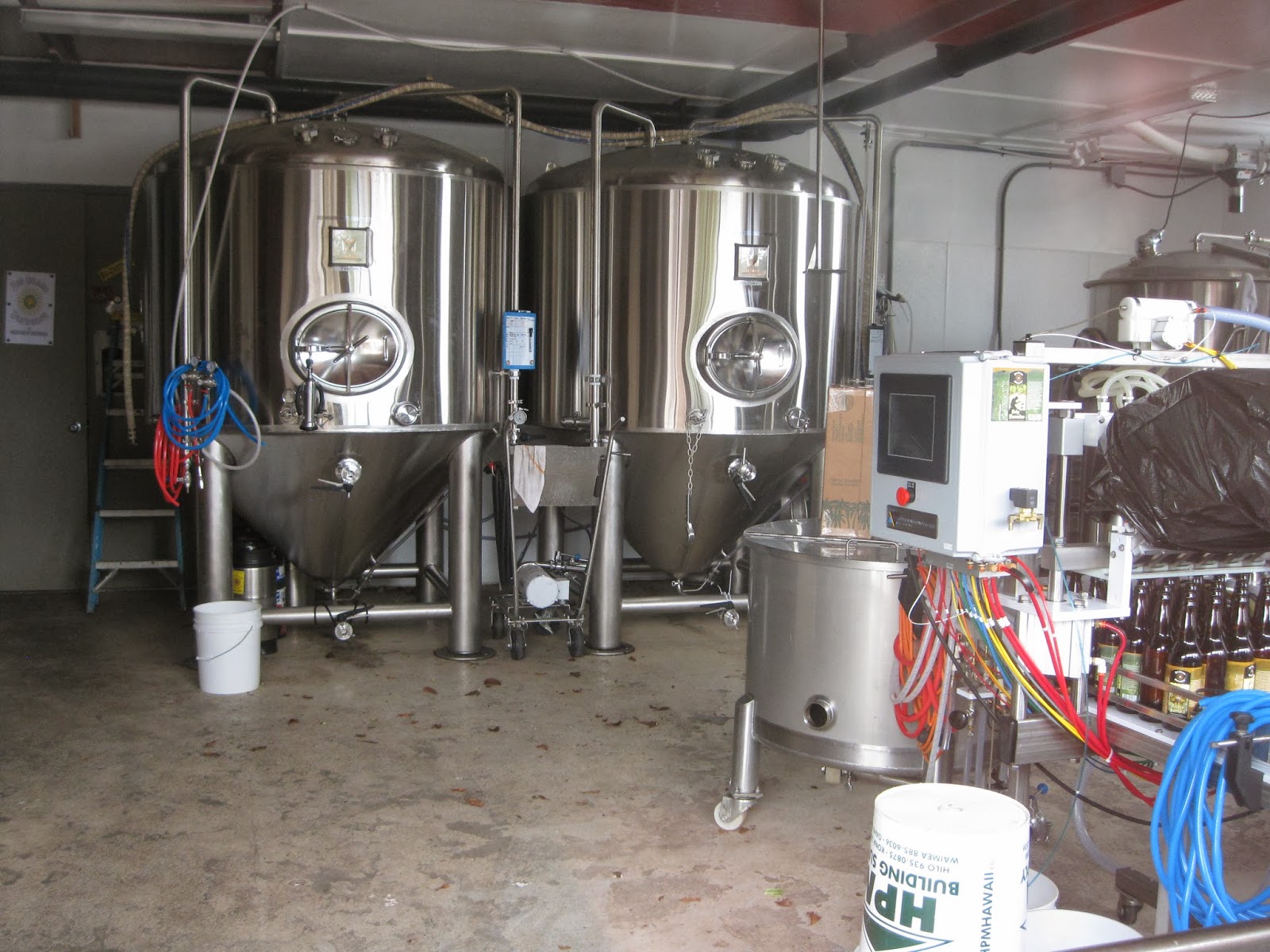
The Big Island Brewhaus brewery itself is located in a tiny little strip mall, alongside a hunting supply shop and a bicycle store. The place was locked up and empty when we were there--the only sign of life coming from a bubbling barrel of trub on a pallet out front--but I peeped through the window to get a look at the brewing set-up. I'm guessing it's around 15 barrel system, with around four fermenters. They've also got a small bottling system for the 22 oz bottles you can get on Oahu. There's a picture below--if you've got a different guess about system size, or if there's anything else interesting you notice from the picture, please feel free to mention it in the comments section of this post.

Big Island Brewhaus also owns and runs a small Mexican restaurant and bar, located in a free-standing building on the property. We went in for lunch and got a sampler of every beer they had available (picture below). Despite the German-influenced name of the brewery, the beer lineup didn't swing toward lager-dominance. Of the eleven beers we tried, about half of them were Ales, and the majority of the rest of the lineup used Belgian-yeasts. Here's a link to the beer descriptions they list on their website, though the list doesn't reflect all of the beers on hand during our visit. Another thing I noticed: grain-wise, the beers on hand seemed to focus on what I think of as "mid-range" grain bills--mostly pale and some caramelized grains, mostly 5-7% alcohol. The only beer that had any roast to it was the White Mountain Porter--I guess they also brew a Guinness style stout, but it wasn't on hand when we were there.
All the beers tasted good to me. My favorite was a Sierra Nevada-styled beer called Paniolo Pale Ale, and what I loved about it was the way the cascade hops came through in the aroma. They smelled super green and fresh, just like the smell you get right when you throw the hops in the boiling kettle. And that helped solidify another thing I've been noticing about beer on the islands--that heady, resinous aroma that I love about West Coast Pale Ales and IPAs is hard to come by here, even in beers that are famous for it like Sierra Nevada, because boat-shipped beers are never gonna be as fresh as what you'll get on the mainland. One more argument for homebrewing in Hawaii.

Another beer that stood out to me was, I think (memory's not too clear on this one), a Pale Ale brewed with ginger. I swear to Ninkasi the beer tasted almost exactly like the Sage Pale Ale I brewed a couple months back, though they say they used ginger and not sage.
As for the food, it was pretty good--probably better than a lot of the Mexican food I've had in Hawaii, but still not up to California standards. My wife gives them super-extra-credit for having real chips--actual tortillas cut into triangles and then deep fried. But my step-dad thought the hot-sauce was seriously lacking in sufficient hotness. I'm not a spicy food connoisseur, but I agree the spice seemed pretty tame. And I also think it's worth noting that the dude who served us was friendly and helpful and on top of it, even though he was working alone during the lunchtime rush.
Big Island Brewhaus is located in a little town called Waimea. It's about an hour's drive from Kona, and about a million miles away in terms of atmosphere: Waimea is paniolo (Hawaii cowboy) territory, with lots of ranches and cattle and big trucks and motorcycles. The altitude is 2670 feet above sea level, and the air is cooler and moister than Kona seaside air. The people in the area struck me as more of a mix of European and Polynesian ethnicity, whereas Honolulu definitely reflects more Japanese and Chinese influence.
The Big Island Brewhaus brewery itself is located in a tiny little strip mall, alongside a hunting supply shop and a bicycle store. The place was locked up and empty when we were there--the only sign of life coming from a bubbling barrel of trub on a pallet out front--but I peeped through the window to get a look at the brewing set-up. I'm guessing it's around 15 barrel system, with around four fermenters. They've also got a small bottling system for the 22 oz bottles you can get on Oahu. There's a picture below--if you've got a different guess about system size, or if there's anything else interesting you notice from the picture, please feel free to mention it in the comments section of this post.
Big Island Brewhaus also owns and runs a small Mexican restaurant and bar, located in a free-standing building on the property. We went in for lunch and got a sampler of every beer they had available (picture below). Despite the German-influenced name of the brewery, the beer lineup didn't swing toward lager-dominance. Of the eleven beers we tried, about half of them were Ales, and the majority of the rest of the lineup used Belgian-yeasts. Here's a link to the beer descriptions they list on their website, though the list doesn't reflect all of the beers on hand during our visit. Another thing I noticed: grain-wise, the beers on hand seemed to focus on what I think of as "mid-range" grain bills--mostly pale and some caramelized grains, mostly 5-7% alcohol. The only beer that had any roast to it was the White Mountain Porter--I guess they also brew a Guinness style stout, but it wasn't on hand when we were there.
All the beers tasted good to me. My favorite was a Sierra Nevada-styled beer called Paniolo Pale Ale, and what I loved about it was the way the cascade hops came through in the aroma. They smelled super green and fresh, just like the smell you get right when you throw the hops in the boiling kettle. And that helped solidify another thing I've been noticing about beer on the islands--that heady, resinous aroma that I love about West Coast Pale Ales and IPAs is hard to come by here, even in beers that are famous for it like Sierra Nevada, because boat-shipped beers are never gonna be as fresh as what you'll get on the mainland. One more argument for homebrewing in Hawaii.
Another beer that stood out to me was, I think (memory's not too clear on this one), a Pale Ale brewed with ginger. I swear to Ninkasi the beer tasted almost exactly like the Sage Pale Ale I brewed a couple months back, though they say they used ginger and not sage.
As for the food, it was pretty good--probably better than a lot of the Mexican food I've had in Hawaii, but still not up to California standards. My wife gives them super-extra-credit for having real chips--actual tortillas cut into triangles and then deep fried. But my step-dad thought the hot-sauce was seriously lacking in sufficient hotness. I'm not a spicy food connoisseur, but I agree the spice seemed pretty tame. And I also think it's worth noting that the dude who served us was friendly and helpful and on top of it, even though he was working alone during the lunchtime rush.
Wednesday, October 2, 2013
Griz

(This picture of Griz sleeping in his habitual location was taken by Chris G., originally posted on Yelp.)
Back when I lived and brewed in San Francisco I got most of my ingredients and equipment from SF Brewcraft. A dominant, unforgettable (and almost unavoidable) feature of that store was Griz. Griz was a grizzled old guy who looked like Santa Claus dressed in overalls. You were pretty-much guaranteed to see him unless you came in near closing, and if you saw him, guaranteed he'd be sitting in the easy chair in the back right corner of the shop. No matter what you knew about brewing, what you came into the shop for, or what type of person you were, Griz would be a key part of your Brewcraft experience.
Griz was an interesting guy. Despite the fact that he never seemed to get out of that easy chair, his presence filled every corner of the shop. You could ask him about any topic related to brewing--and probably plenty of topics completely unrelated--and rely on an opinionated answer. And Griz was an unapologetic contrarian, too; so if you ever came to him with a plan or an idea, chances are you were wrong. (I wrote about this phenomenon on my old brewing blog, Parkside brewing.)
Some people didn't like the type of experience Griz provided. Whether these people were thin-skinned or just preferred a different level of propriety, there were Brewcraft customers who'd swing by the store right before closing specifically so they wouldn't have to face Griz. And truth be told, I butted heads with Griz a few times myself. There probably aren't many who didn't, unless they had absolutely no stomach for a fight.
That said, I also want to say this: in all of the experiences that I had with Griz, he never struck me as a bully. He spoke his mind because he cared about things, not because he wanted to bend you to his way of thinking. And on the occasions when I saw him realize his plain-spoken manner was bowling someone over, he changed his course and held back.
(I've come to value the unapologetic, opinionated attitude Griz displayed more than ever, now that I live in Hawaii. The brewing scene is so small here, and so fragile, that people seem to go to lengths to avoid confrontation. (You can see it in Beer in Hawaii's post on Aloha Beer's closure, in which author Tim Golden tells us that "the real facts are murky and we may never really know what happend, nor should we really care.", though that's hardly the only example.) I miss being around someone like Griz, who wasn't afraid to ask questions and point out bullshit.)
Here's my favorite Griz memory: I stopped by Brewcraft on a Saturday to pick up grains for the next day's brew. There were a few people in the shop ahead of me--brewing newbies with lots of questions and lots of doubts--and they were peppering the guy behind the cash register with worst-case type scenarios. Griz was in his easy chair, like normal, looking more agitated with each additional question. Before I'd managed to gather my grains, a few more people came into the shop behind me. Apparently Griz's maximum-capacity level had been reached, because he started loudly complaining that there were too many people in the shop. "Eric," Griz shouted, "you gotta get some of these people out of here! It's turning into a clusterfuck. Come on!" Honestly, I can't think of any other time, in my entire life, in which I witnessed a shop owner getting upset about having too customers in his shop.
Thinking about it now, Griz's unapologetic stance might be the greatest thing he ever showed me about brewing. Getting your hands on great beer is pretty easy nowadays, even here in Hawaii, because craft beer is a growing market and plenty of breweries are producing awesome product. Homebrewing isn't a necessity anymore, so if you're gonna homebrew, you should be doing it because you love it, and because you have a particular vision you want to pursue. Passion is the prerequisite, not compromise, and Griz was an incredible example of that.
About a week ago I got an email from SF Brewcraft with the following message: "On the evening of Monday, September 23rd, our friend and teacher Greg Miller, endearingly referred to as Griz, passed. In honor of Griz, Brewcraft will be closed for the next two days and will reopen Thursday, September 26th. We are making plans to have a celebration of his life. We will be posting details soon. Until then thank you for your love and support and for this week please raise a glass and tell a story about Griz."
In my life I've only had the privilege of meeting a very few people who seemed honestly, uncompromisingly themselves, and Griz was definitely amongst that small number. The homebrewing world is a poorer place, now that he's no longer with us.
Tuesday, September 24, 2013
following up on past posts
There's been a couple of interesting developments in the Oahu brew scene recently, and I figured I'd follow up on the ones that relate to things I've posted about here. If you want more comprehensive coverage of the happenings in Hawaii's beer scene, Beer in Hawaii is still the place to go. But if you're just following my blog and are curious about the places I've mentioned, here's what's new:

First of all, back in March I wrote up a pretty extensive post about a visit I'd made to the Aloha Beer brewery. Dave Campbell, Aloha Beer's brewmaster and partial owner, gave me a behind-the-scenes-tour and chatted with me about the brewery's planned expansion--including a massive increase of brewing area/capacity and the creation of a new "Beer Sanctum" space where Sam Choy's bar used to be. A few weeks later, while drinking a few beers at Aloha and chatting with the bartender on hand, I heard a different story: no "Beer Sanctum," no planned expansion, but the brewery would be shut down temporarily for upgrades. The brewery did indeed shut its doors about a month after that, but I haven't seen or heard of any work being done since then, and the doors are still closed almost three months later.
At the REAL tasting event in August I heard a rumor that Aloha Beer's extended closure might have legal reasons behind it--the guy I was talking to hinted that there'd been some kind of "serving to minors" violation--but considering the venue and circumstances(post-REAL-event/more than six beers deep), I didn't put too much stock in it. The most credible news to appear concerning the whole situation came just a little while back, in an online article posted by the Pacific Business News. The article sort of touches on the murkiness of it all--Campbell will neither confirm or deny permanent closure; James Lee (another Aloha Beer owner) claims he's withdrawn his ownership interest, but maintains the "only closed for upgrades" story; Steve Sombrero, the third owner, won't even return calls for comments--but it does provide one firm fact: "The state Department of Labor and Industrial Relations Unemployment Insurance Division in April filed a tax lien against Aloha Beer Co. for $105,740.65 in unpaid employment security tax." That's a pretty large amount of money, and I'm betting the rent owed for the past three (customer-less) months is pretty hefty too. In the end, I'm getting a very bad feeling about the chances of Aloha Beer re-opening ever again.
And speaking of closures, here's more bad news: this is officially Hawaiian Islands Brewing's last month of business. HIB was handling the brewing for VICE Inferno at Ward Center. I wrote about my visit to the place back in February, and I had my doubts about the company's chances of success even back then, though I did think their beer was pretty great. With Aloha Beer indefinitely closed, and Hawaiian Islands Brewing officially closing, Oahu currently has only one commercial business brewing its own beer: Gordon Biersch at Aloha Tower.
But on the bright side: REAL is having enough success to go ahead with expansion--they'll be opening up a smaller pub in Kaimuki called BREW'D pretty soon. And a new 7-barrel brewery called Honolulu Beerworks is in the works for the KaKa'ako.

First of all, back in March I wrote up a pretty extensive post about a visit I'd made to the Aloha Beer brewery. Dave Campbell, Aloha Beer's brewmaster and partial owner, gave me a behind-the-scenes-tour and chatted with me about the brewery's planned expansion--including a massive increase of brewing area/capacity and the creation of a new "Beer Sanctum" space where Sam Choy's bar used to be. A few weeks later, while drinking a few beers at Aloha and chatting with the bartender on hand, I heard a different story: no "Beer Sanctum," no planned expansion, but the brewery would be shut down temporarily for upgrades. The brewery did indeed shut its doors about a month after that, but I haven't seen or heard of any work being done since then, and the doors are still closed almost three months later.
At the REAL tasting event in August I heard a rumor that Aloha Beer's extended closure might have legal reasons behind it--the guy I was talking to hinted that there'd been some kind of "serving to minors" violation--but considering the venue and circumstances(post-REAL-event/more than six beers deep), I didn't put too much stock in it. The most credible news to appear concerning the whole situation came just a little while back, in an online article posted by the Pacific Business News. The article sort of touches on the murkiness of it all--Campbell will neither confirm or deny permanent closure; James Lee (another Aloha Beer owner) claims he's withdrawn his ownership interest, but maintains the "only closed for upgrades" story; Steve Sombrero, the third owner, won't even return calls for comments--but it does provide one firm fact: "The state Department of Labor and Industrial Relations Unemployment Insurance Division in April filed a tax lien against Aloha Beer Co. for $105,740.65 in unpaid employment security tax." That's a pretty large amount of money, and I'm betting the rent owed for the past three (customer-less) months is pretty hefty too. In the end, I'm getting a very bad feeling about the chances of Aloha Beer re-opening ever again.
And speaking of closures, here's more bad news: this is officially Hawaiian Islands Brewing's last month of business. HIB was handling the brewing for VICE Inferno at Ward Center. I wrote about my visit to the place back in February, and I had my doubts about the company's chances of success even back then, though I did think their beer was pretty great. With Aloha Beer indefinitely closed, and Hawaiian Islands Brewing officially closing, Oahu currently has only one commercial business brewing its own beer: Gordon Biersch at Aloha Tower.
But on the bright side: REAL is having enough success to go ahead with expansion--they'll be opening up a smaller pub in Kaimuki called BREW'D pretty soon. And a new 7-barrel brewery called Honolulu Beerworks is in the works for the KaKa'ako.
Wednesday, September 18, 2013
Tasting the Sage Pale Ale
The Sage Pale Ale I brewed a while back is at peak drink-ability right now, so I figured I'd write up tasting session notes for it, like I did for my Poi Wheat Ale back in March.

Aroma: Floral hop notes mixed with an apparent sage smell, and, inexplicably, a hint of "soap."
Appearance: Rich yellowish orange color. Clear enough to see the rising bubbles sharply, but not clear enough to read through. Copious frothy head that fades to a loose-packed, big-bubble cap.
Flavor: Pronounced bitterness initially, with sage kicking in halfway through, and sage and bitterness lingering long afterwards. Malt flavors are definitely taking second-seating to the hop-bitterness and the sage. And the sage flavor brings poultry dishes to mind, though of course there isn't any chicken/turkey taste to the beer. (This flavor-association phenomena reminds me of a tasting I attended at the Alaskan Brewing Company in Juneau. The standout beer on tap was, by far, their Smoked Porter, which features grains smoked with alder wood. Alder wood is commonly used to smoke salmon, too, and the alder flavor present in the beer made some people think the beer had fish in it.)
Mouthfeel: Very light in body (a successful result of my low-mash-temperature approach to this brew). Despite the flowing bubbles, the beer doesn't have any serious carbonation tingle. When you get most of the way through the glass, the hop and sage oils start to make the tongue feel a bit pickled.
Overall Impression: Pretty good! Provides the crisp, herb-oriented satisfaction of a Pale Ale, but it's definitely a unique experience because of the sage. I also appreciate the fact that it offers that herb-fix without the weight of an IPA (OG = 1.044, FG = 1.006; 5% estimated abv).
Other Info: I'm pretty happy with how this beer turned out. In fact, I'm happy enough to feel like it's worth sharing. If any local Homebrewing in Hawaii readers are curious to see how culinary sage fits into a Pale Ale style, feel free to send me an email at: mf.soriano (at) yahoo (dot) com. We can do a homebrew bottle trade!
Aroma: Floral hop notes mixed with an apparent sage smell, and, inexplicably, a hint of "soap."
Appearance: Rich yellowish orange color. Clear enough to see the rising bubbles sharply, but not clear enough to read through. Copious frothy head that fades to a loose-packed, big-bubble cap.
Flavor: Pronounced bitterness initially, with sage kicking in halfway through, and sage and bitterness lingering long afterwards. Malt flavors are definitely taking second-seating to the hop-bitterness and the sage. And the sage flavor brings poultry dishes to mind, though of course there isn't any chicken/turkey taste to the beer. (This flavor-association phenomena reminds me of a tasting I attended at the Alaskan Brewing Company in Juneau. The standout beer on tap was, by far, their Smoked Porter, which features grains smoked with alder wood. Alder wood is commonly used to smoke salmon, too, and the alder flavor present in the beer made some people think the beer had fish in it.)
Mouthfeel: Very light in body (a successful result of my low-mash-temperature approach to this brew). Despite the flowing bubbles, the beer doesn't have any serious carbonation tingle. When you get most of the way through the glass, the hop and sage oils start to make the tongue feel a bit pickled.
Overall Impression: Pretty good! Provides the crisp, herb-oriented satisfaction of a Pale Ale, but it's definitely a unique experience because of the sage. I also appreciate the fact that it offers that herb-fix without the weight of an IPA (OG = 1.044, FG = 1.006; 5% estimated abv).
Other Info: I'm pretty happy with how this beer turned out. In fact, I'm happy enough to feel like it's worth sharing. If any local Homebrewing in Hawaii readers are curious to see how culinary sage fits into a Pale Ale style, feel free to send me an email at: mf.soriano (at) yahoo (dot) com. We can do a homebrew bottle trade!
Wednesday, September 11, 2013
learning to love Belgian yeast strains

I've said it before, and I'll say it again: British and Irish ales are my favorite styles of beer. Back in San Francisco I brewed those styles, or American takes on those styles, more than anything else. I've been trying to do them here in Hawaii too, but it hasn't been easy. Most British and Irish ale yeasts prefer cool-fermentation temperatures, ideally around 65 degrees Fahrenheit. The climate in San Francisco (where I lived before moving here) is often perfect for that; the climate in Honolulu... not so much.
I've brewed around nine beers here so far using British Ale yeasts, and the fermentation temperatures have always been over 72 degrees Fahrenheit. Most of the beers have turned out okay--but the fermentations were often violent, with foam-overs and even one spectacular eruption. And the flavors haven't been as clean as what I was getting in San Francisco.
So I'm starting to experiment with Belgian yeasts now. A lot of Belgian strains are happy fermenting above 70 degrees Fahrenheit, and some of them have no problems with temperatures even higher than that. For my first Belgian beer here in Hawaii, I used White Labs 545 Belgian Strong Ale yeast. The label on the vial gives the fermentation temperature range as 70 to 75 degrees, and I think my fermentation managed to remain within that range. I definitely noticed a smoother, less violent fermentation. I'll try to remember to post here about how the final beer turns out.
Wednesday, September 4, 2013
British Beers at House of Brews
Bar 35 hosts a beer event every Wednesday called "House of Brews." It costs $25 a person, and that gets you 9 beer tasters and a few pizza appetizers. Last week (August 28, 2013) the event focused on British Beers, and because of my love of British styles, my wife and I decided to check it out.
It turned out to be a pretty low-key affair. Basically, you let the man behind the bar know that you're there for the beer event, and they give you a blue wrist-band with nine pull-off tabs (you can see it in the picture above). After that you can sit anywhere in the bar, or out on the back patio, and they bring the beer tasters to you one at a time. Event organizer Tim Quirante (who was recently interviewed by Beer in Hawaii) makes the rounds, sitting down with you for a few minutes with each beer to give you the scoop.
The line-up for last week's event featured eight beers, with a chance to revisit a beer with a second tasting after you'd had them all. The beers on hand where: John Smith's Extra Smooth, Newcastle Werewolf, Newcastle Brown Ale, Boddingtons Pub Ale, Samuel Smith's India Ale, Harviestoun Old Engine Oil, Greene Kind Old Suffolk, and Samuel Smith's Imperial Stout. The Harviestoun and the Greene King were new to me, and Greene King's Olde Suffolk in particular was a standout--rich and complex, with a notable Oak character--excellent! Apparently I wasn't the only person to think so--they ran out before I had a chance to revisit it with my ninth taster. I ended up going back for seconds on the Samuel Smith's India Ale instead--a great beer from one of my favorite breweries.
Toward the end of the event I had a chance to chat with Tim Quirante about his new job brewing part time at Hawaii Nui, and about his Chico, California roots. He mentioned he'd be flying to the Big Island on Sunday for his first solo brew on Hawaii Nui's system, a batch of Mehana Mauna Kea Pale Ale. I was a bit surprised to hear that. Brewing five gallon batches is hard enough to do alone--I often force my wife to help me out with certain steps--but Tim's going to be doing a brew on Hawaii Nui's 30 barrel system all on his own. Apparently that's they way they do it there.
Subscribe to:
Posts (Atom)